

Who Wrote SCFTU and Why?
Sanctuary Cities for the Unborn ordinances didn’t just appear out of nowhere. They weren’t dreamed up by local voters or even by local leaders responding to community concern. SCFTU are the product of a strategic, well-funded, religiously driven campaign led by Mark Lee Dickson who travels town to town selling fear, legal tricks, and religious posturing.
The men behind this ordinance aren’t neutral legal experts. They are attorneys and lobbyists with a singular idealogical mission: to use the law as a weapon to punish anyone who supports abortion access, and they don’t mind trampling on your rights along the way. Let’s dish:

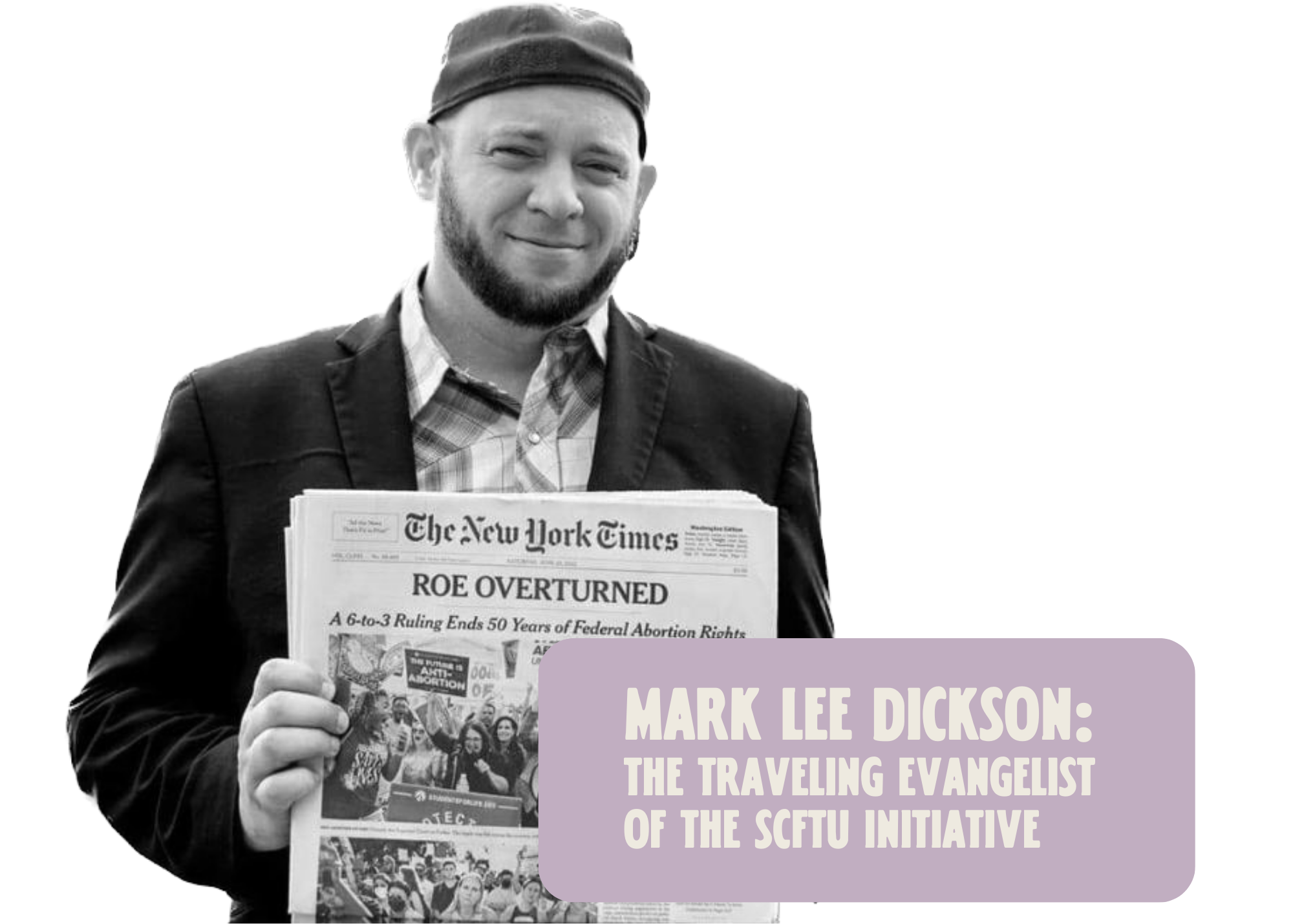
Mark Lee Dickson is an extremist right-wing lobbyist and the public face/chief promoter of the SCFTU movement. A pastor (with no formal seminary training) and longtime anti-abortion activist originally associated with Right to Life of East Texas, Dickson brought his ideas to the forefront in 2019, when he convinced the all-male city council of Waskom, Texas, to pass the first Sanctuary City for the Unborn. Since, he has plagued counties and cities across Texas and the country pushing his extremist agenda.
Dickson’s work consists of driving to cities in an attempt to pressure local governments into passing his extremist legislation. He has been broadly successful in targeting Republican-led, all-male city councils. He strategically waited for Amarillo city leadership to change before striking here.
Dickson often frames these efforts as local, grassroots initiatives. However, reporting has shown that the ordinance language used in different towns is frequently nearly identical, raising questions about how “local” the proposals truly are. The Texas Observer detailed how outside activists played a central role in Amarillo’s SCFTU fight, including coordination and messaging strategies that were not homegrown.
Dickson’s messaging frequently centers on the idea of “abortion trafficking,” a term used to describe helping someone travel out of state for abortion care. This framing effectively attempts to restrict constitutional travel rights by threatening lawsuits against people who assist someone seeking legal medical care elsewhere.
Fun fact: Dickson claims to be a 40-year old virgin. The irony of a virgin trying to legislate reproductive care is not lost on us. It’s a glaring disconnect between personal experience and the ability to empathize with the complex realities of those directly affected.
When a cis-male, who claims to be a virgin, decides that they’re the authority on abortion, it not only raises concerns about his limited firsthand understanding of sex in general, but it also undermines the very real experiences of pregnant people everywhere. It overlooks the physical, emotional, and sometimes medical challenges that people face in making such healthcare decisions.
Dickson’s lack of ~ personal experience ~ perpetuates a culture that fails to acknowledge and respect bodily autonomy. Everyone deserves the right to make personal and private medical decisions without interference, especially from a person who isn’t even a part of their community (much less a virgin). If anything, this highlights the need for legislators, local and beyond, to prioritize perspectives that are based in science and rooted in a deep understanding of the intricacies involved in reproductive health and choice. Our legislators have a duty to protect the rights and well-being of those who would be impacted the most by Dickson’s ignorant policies.
The most heinous part of these ordinances is that Dickson’s goal is fear and isolation. He aims to isolate pregnant people from their loved ones. By cutting people off from their support networks, SCFTU ordinances create a climate of fear and apprehension. A pregnant person may feel isolated or unsupported in their decisions, and their loved ones would be unable to offer any advice, help, or resources without being sued.
It is essential that policy makers take into account the experiences of individuals who may find themselves in situations where abortion is a legitimate and necessary option. City councils must respect the rights of ALL their citizens, and their right to make personal and private healthcare decisions without judgement or undue interference.
Dickson has also been involved in legal disputes related to his public statements about abortion funds. Several Texas-based funds sued him for defamation after he publicly labeled their work “criminal.” The Texas Tribune covered the case and its eventual journey to the Texas Supreme Court. While the court ruled in his favor on procedural grounds, the dispute highlighted how aggressively abortion funds and support networks are characterized under his “advocacy.”
This pattern of aggressive labeling combined with broad legal language mirrors how SCFTU ordinances operate on the ground. The civil enforcement structure encourages private citizens to file lawsuits against one another, amplifying tension and division within communities, proving that his goal has nothing to do with abortion and everything to with division and control.


The Legal Architect Behind SCFTU
If Mark Lee Dickson is the prothselytizer selling the ordinance, Jonathan Mitchell is the attorney building the machinery behind it. Think of him as the covert legal muscle working behind the scenes.
A former Texas Solicitor General (2010-2015), Mitchell is most known for writing the civil action, AKA the “Bounty Hunter Law,” included in Texas’ Heartbeat Bill (SB 8, Sep. 1st, 2021) that allows Texans to pursue civil suits against people who they accuse of aiding or abetting an abortion. Sound familiar? That structure was widely described by legal scholars as an intentional attempt to insulate abortion restrictions from pre-enforcement judicial review.
These laws are purposefully written to be vague so that when cities are sued, he can represent them. He preemptively offered to represent the City of Amarillo pro bono (a move he uses in almost every town where Dickson needs a boost in city council discussions). He aims to argue in front of SCOTUS to change our laws and continue to push his right-wing agenda.
Mitchell has been explicit in interviews and legal writings that he views procedural barriers, such as standing requirements and traditional enforecement limits, as obstacles to be ~ creatively ~ navigated. His legal strategy does not focus primarily on persuading courts to uphold controversial policies; instead, it often focuses on designing laws in ways that make them difficult to challenge in the first place.
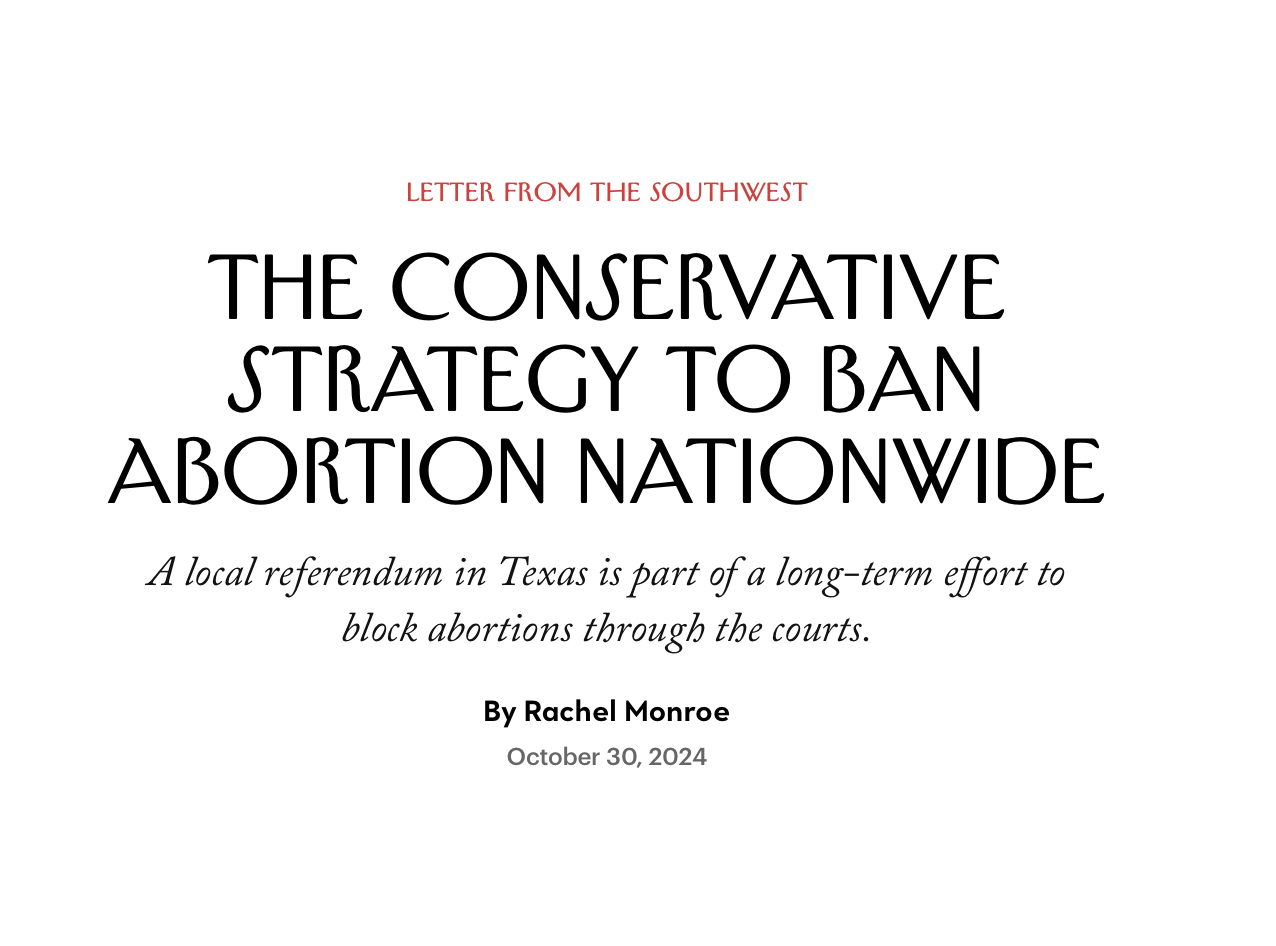
This same legal strategy underpins many SCFTU ordinances.
Under Mitchell’s framework, enforcement is outsourced to private individuals rather than government officials. Instead of police or prosecutors bringing cases, private citizens can file civil lawsuits - often with statutory damages of at least $10,000 per alleged violation. This mechanism was widely covered in national reporting, including analysis in The New Yorker examining how the enforcement model reshaped abortion litigation strategy.
Mitchell has also been linked to efforts to revive or reinterpret older federal statues, such as the Comstock Act (a law from the 1800s!), in ways that could further restrict abortion-related services.
A defining feature of Mitchell’s approach is expanding who can bring a lawsuit, loosening traditional standing requirements so that individuals who were not directly harmed can still sue. This is central to how SCFTU ordinances function. By broadening who can claim injury, these ordinances allow ideologically motivated individuals to file cases they have no personal connection to the alleged action. This framework shifts financial risk onto everyday people, families, and local businesses.

They’re in it for themselves.
If you zoom out, a pattern starts to emerge in how Mark Lee Dickson and Jonathan Mitchell operate. It’s not just what they advocate for — it’s how they design the systems around it.
A 2024 investigation by Texas Monthly dug into who was paying the legal bills in a high-profile defamation case involving Dickson. The article revealed that Sovereign Love Church, located in a small East Texas town where Dickson serves as “pastor,” covered substantial legal fees connected to the lawsuit. Because churches aren’t required to publicly disclose donors the way political organizations are, it remains unclear who ultimately financed that legal defense, though many suspect billionaires Wilks + Dunn have contributed. When questioned in court, neither Dickson nor his attorney, Jonathan Mitchell, could clearly identify all contributors who funded the litigation.

That opacity matters. Especially when the same people are simultaneously traveling the state urging small-town councils to adopt ordinances that expose everyday folks to $10,000 civil penalties.
Public records show that Sovereign Love Church (pictured here) operates out of a modest strip-mall storefront in East Texas. While this run-down, near abandoned “church” might be small in size, the legal footprint it leaves is not.
This raises some questions, to say the least.
When an ordinance campaign spans multiple states, involves coordinated legal drafting, and triggers high-dollar litigation, people naturally want to know 1-Who is paying for all this? 2-Who is actually benefiting from this? and 3-Why is the funding sooo difficult to trace? While all of this isn’t illegal, it is revealing. When you look at the pattern - the traveling ordinance template, the coordinate legal engineering, the donor secrecy, the fee structures routed through abandoned chruches - it stops feeling less and less accidental and more intentional.
SCFTU ordinances do not exist in isolation. They’re a part of a broader political project driven by well-funded lobbying networks, religious nationalist ideology, and a growing movement that seeks to reshape American law around a narrow, exclusionary vision of who deserves autonomy and power.
Reproductive justice teaches us that the right to have children, not have children, and raise families in safe and supported communities is inseparable from the fight against white supremacy, economic inequality, and authoritarian governance. When laws are crafted to police bodies, punish care, and silence dissent, they reinforce the same systems that have historically controlled marginalized communities first and most severely.
That is why this fight matters at every level. From local ballot measures to the statehouse and beyond, poorly written and ideologically driven legislation does not just appear; it’s organized, funded, and lobbied into existence. And it can be organized against. Protecting reproductive freedom means challenging these efforts wherever they surface.